Subterranean termites, primarily the Formosan subterranean termite (*Coptotermes formosanus*), enter structures from underground nesting networks rather than aerial wood drops. In Honolulu County, microclimates dictate…
Subterranean termites, primarily the Formosan subterranean termite (*Coptotermes formosanus*), enter structures from underground nesting networks rather than aerial wood drops. In Honolulu County, microclimates dictate soil saturation protocols. Properties situated in high-moisture valley belts like Manoa and Nuuanu experience faster chemical dilution from watershed runoff, requiring water-insoluble termiticides bound tightly to the top 6 inches of soil. Conversely, coastal slabs in Waikiki, Kahala, and Hawaii Kai deal with hyper-porous sandy substrates where liquid barriers must be injected deeper to prevent colony tunneling underneath perimeter footings. Unlike drywood termites which live entirely inside framing lumber and yield to whole-home fumigation, subterranean species require foundation-level interruption; tent fumigation leaves soil colonies completely viable, allowing workers to rebuild mud tubes within weeks of gas aeration.
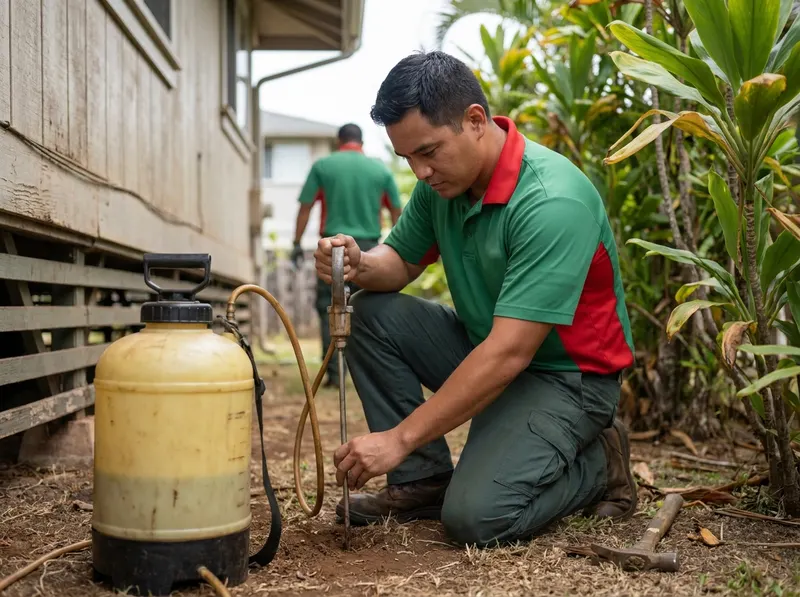
The primary mechanical intervention involves trenching perimeter dirt to a depth of 6 inches and injecting non-repellent liquid termiticide at a standard rate of 4 gallons per 10 linear feet. For structures with adjoining concrete lanais, driveways, or carports common in Makiki, Moiliili, and Kaimuki, technicians drill 0.5-inch vertical access holes spaced 12 inches apart through the slab to saturate the sub-grade fill, sealing each opening with exterior-grade hydraulic cement upon completion. Where ground-disturbance regulations or high water tables exist, such as low-elevation parcels along the Ala Wai canal or near Ala Moana Regional Park, exterior bait matrices containing insect growth regulators serve as the primary containment method. The mechanical trade-off rests between immediate continuous chemical barriers, which require minor perimeter drilling, versus slower bait matrix interception, which avoids masonry penetration but requires 60 to 90 days to achieve colony collapse.
Formosan subterranean termites maintain colonies numbering upwards of several million foragers, transporting moisture inside hollow mud tubes to sustain wood consumption above the foundation line. Property owners in older valley neighborhoods like Kalihi and wood-framed residences near Punchbowl Crater frequently mistake subterranean mud tubes along foundation stem walls for simple dirt streaks. Applying retail surface aerosol sprays kills only visible foraging workers, causing the colony to seal off that satellite pathway and reroute structural consumption behind drywall or flooring unseen. Proper remediation halts the subterranean supply line permanently using non-repellent chemistries that foragers track back into the royal chamber.
Every job gets a firm, written price after a free on-site visit.
Tell us about your subterranean termite treatment service job in Honolulu and we'll send a clear, written quote, usually the same day.
 Cadrin Bug Removal